
Practical Guide • Retail • Sydney
Retail Security Sydney: How Loss Prevention Guards Work
Australian retail crime cost the sector $7.79 billion in 2023-24. Theft incidents hit their highest level in 21 years. A visible, licensed loss prevention guard at the entrance reduces shoplifting by deterring opportunistic theft — but their real value is in how they’re briefed, what they can legally do, and whether the ROI justifies the cost. Here’s the honest picture.
Primary sources: NSW Crimes Act · NSW Police SLED licence register.
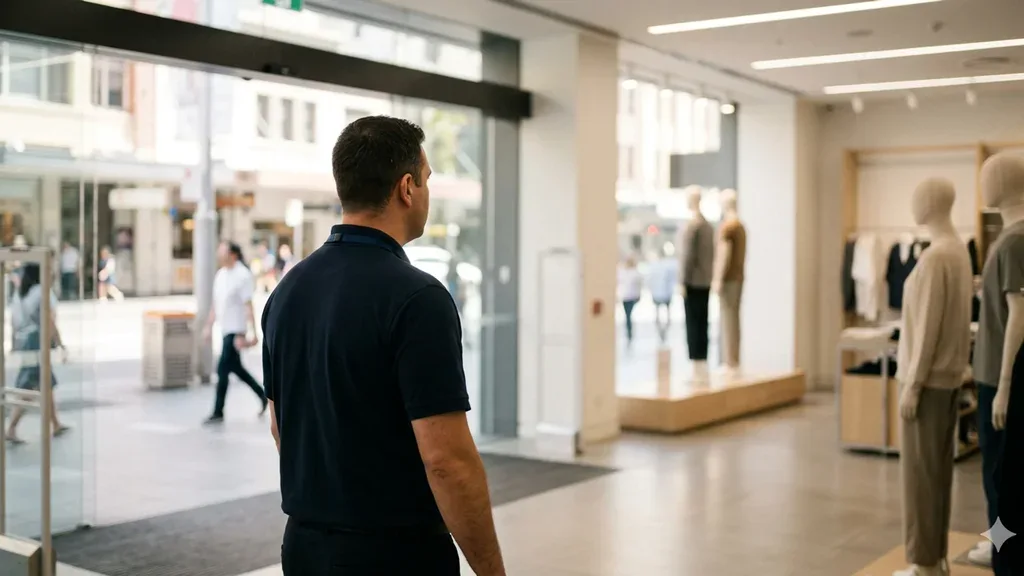
The Real Cost of Retail Theft in Australian Stores
The numbers from the 2024 Australian Retail Crime Report (Griffith University / ANZ Retail Crime Study):
- $7.79 billion total cost of retail crime in Australia in 2023-24
- Theft by customers accounted for 53% of total shrinkage
- Internal theft (employee) accounted for 22%
- Incidents of business theft surged 20% in the first eight months of 2025
For a Sydney retail shop doing $500,000/year in revenue, average shrinkage of 3–5% = $15,000–$25,000 in annual losses. A loss prevention guard for trading hours costs $35,000–$45,000/year in wages — which pays for itself if they prevent even half the expected shrinkage.
What a Retail Loss Prevention Guard Actually Does
- Visible deterrence at the entrance. Most opportunistic shoplifters decide within the first 10 seconds whether to attempt theft. A uniformed guard at the door shifts that calculation immediately.
- Customer greeting and monitoring. A guard who greets every customer is also identifying who enters and creating a psychological barrier to theft (the thief knows they've been seen).
- CCTV coordination. In stores with cameras, the guard monitors live feeds and directs attention to suspicious behaviour.
- Incident response. When theft is observed, the guard approaches, asks for the item, and if necessary contacts police. They do NOT tackle, chase into the street, or physically restrain (see legal powers limitations).
- Reporting. Daily incident logs, CCTV timestamp notes for police, and trend data for the store manager.
Visible Deterrence vs Plainclothes Loss Prevention
Uniformed (visible): Best for preventing theft before it happens. The guard's presence is the point — opportunistic thieves move to an unguarded store. Effective for small-to-medium retail with a single entrance. Cost: standard guard rates ($40–$55/hr).
Plainclothes: Best for catching organised theft rings that case stores over multiple visits. The plainclothes officer blends with shoppers and identifies systematic offenders. More common in large retail (department stores, electronics chains). Cost: premium rates ($55–$75/hr) due to specialised skill.
For most Sydney SMB retail, uniformed is the right choice — you want prevention, not prosecution. Plainclothes makes sense for stores losing $50,000+/year to organised theft.
Calculating Whether a Guard Pays for Itself
Simple ROI math for a Sydney retail shop:
- Annual shrinkage without guard: $20,000 (3% of $650K revenue)
- Estimated reduction with guard: 40–60% of opportunistic theft prevented
- Theft prevented: $8,000–$12,000/year
- Annual guard cost (trading hours, 5 days/week): ~$35,000–$45,000
- Net cost of guard after theft prevention: $23,000–$37,000/year
On pure shrinkage math, the guard doesn't fully pay for itself in most SMB retail. But the calculation misses three things: insurance premium reductions (5–10% with a guard), staff safety and confidence (retail workers report feeling safer with security present), and customer experience (legitimate shoppers prefer stores that feel controlled). When you factor those in, the ROI tips positive for most shops losing more than $10,000/year to theft.
Frequently Asked Questions
How much does a retail security guard cost in Sydney?+
$40–$55/hr for a uniformed loss prevention guard during standard trading hours. For a 5-day/week, 8-hour/day arrangement: approximately $35,000–$45,000/year. Volume contracts with multiple stores or extended hours negotiate lower rates.
Can a security guard stop a shoplifter in NSW?+
A guard can approach a suspected shoplifter, ask for the item, and request they remain while police are called. They CANNOT physically restrain, tackle, or chase a shoplifter for typical retail theft (under the $300 threshold, it doesn't qualify for citizen's arrest). The guard's role is observe, approach, de-escalate, and call police.
Does having a security guard reduce retail theft?+
Yes — visible guard presence reduces opportunistic shoplifting by 40–60% in most studies. Organised theft is harder to deter with a single guard. The deterrence effect is strongest at single-entrance stores where the guard sees every customer enter and exit.
Is a security guard or CCTV better for retail theft prevention?+
For deterrence: a guard is more effective — a camera doesn't physically prevent someone from walking out. For evidence: CCTV is essential — it provides footage for police and insurance claims. Most retailers with a significant theft problem need both: guard for active deterrence + CCTV for evidence and after-hours coverage.
What should I include in a retail guard briefing?+
Store layout, high-theft zones, known offender descriptions (if any), escalation procedure (when to call police vs when to approach), bag check policy (if applicable), interaction style with customers (friendly, not aggressive), and incident reporting requirements.
Can a retail guard search bags?+
Only with the customer's consent. Many stores post signage at the entrance stating 'bags may be inspected on exit' — entering the store constitutes implicit consent. If a customer refuses a bag check, the guard cannot force a search. They note the refusal and check CCTV for that customer's time in-store.
Need loss prevention for your Sydney retail store?
We provide licensed retail security guards for Sydney shops — uniformed deterrence, customer-friendly approach, daily reporting to your store manager.
Related Reading
- Cost GuideSecurity Guard Cost SydneyFull rate breakdown including retail trading-hours guards.
- LegalWhat Guards Can and Can't DoKnow the legal boundaries before briefing your retail guard.
- ComparisonGuard vs CCTVWhen cameras complement guards in a retail setting.
- ServiceSRS Security Guards SydneyMandatory cluster service-hub link.
- ComparisonStatic vs Mobile PatrolRetail uses both
- ComplianceVerify Security Licence NSWCompliance step before engagement.