
Security • Buyer Guide • Sydney
Static vs Mobile Patrol Guards: Which Does Your Site Need?
Static guard or mobile patrol — the decision is usually about response time vs cost. A static guard is on-site immediately; mobile patrol responds in 10–30 minutes but costs 40–60% less per night. Both need the same NSW Class 1A licence — so the question isn’t “which is more qualified,” it’s “which deployment model fits your risk.” Here’s how a licensed Sydney provider decides.
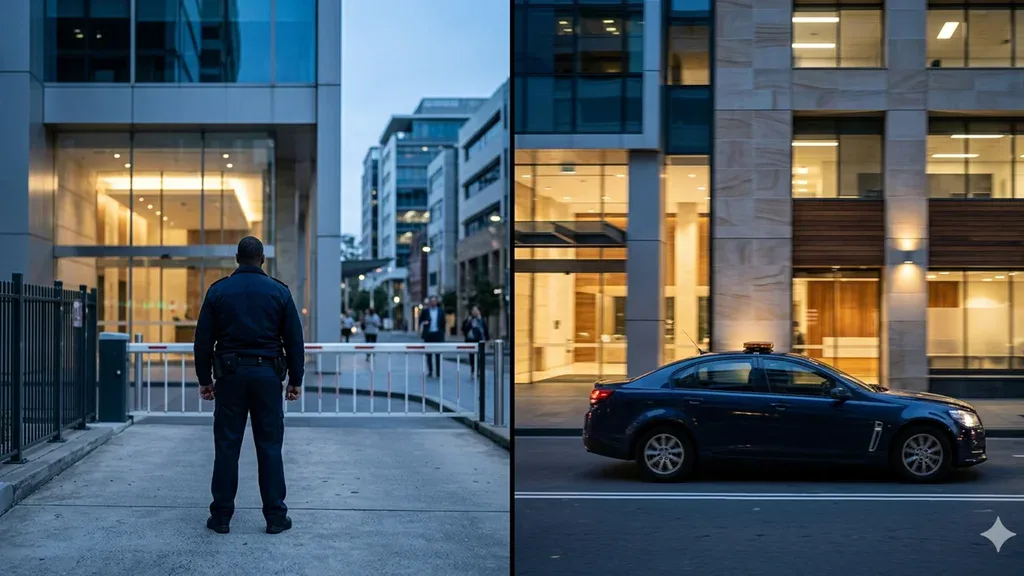
The Short Answer — Feature Comparison at a Glance
| Capability | Static guard | Mobile patrol |
|---|---|---|
| Coverage area | One site, continuously | Multiple sites per shift |
| On-site response time | Immediate | 10–30 minutes |
| Typical hourly/site cost | $40–$55/hr (weekday) | $30–$60/site visit |
| Typical weekly cost (overnight) | $1,800 – $2,200/month | $800 – $1,200/month |
| Best for continuous presence | Yes | No |
| Best for unpredictability / multi-site | No | Yes |
| NSW licence required | Class 1A | Class 1A + driver's licence + First Aid |
| Suits active-hours operations | Yes | No |
| Suits after-hours / unoccupied sites | Sometimes (if risk justifies) | Yes |
| Deterrence model | Continuous visible presence | Unpredictable timing |
What a Static Guard Actually Does
A static guard is stationed at a fixed position — typically a building entry, gatehouse, reception desk, or perimeter checkpoint. They remain on-site for the full shift duration. Their core duties:
- Access control: Verifying credentials, checking IDs, maintaining visitor logs, controlling entry/exit
- CCTV monitoring: Watching live camera feeds from an on-site control point and flagging anomalies in real time
- Patrol rounds within the site: Conducting interior or perimeter checks on a scheduled basis — but confined to the assigned property
- Immediate incident response: Because they’re physically on-site, response time to any incident is zero travel — they’re there when it happens
- Visitor and staff liaison: Often the first point of contact for anyone entering the site
- Incident reporting: Daily occurrence log documenting activity, incidents, and anomalies for the client
Static guards are the right call where continuous, visible presence at a specific point matters — and where the cost of even a 15-minute response gap is unacceptable.
What Mobile Patrol Actually Does
A mobile patrol officer works from a marked vehicle and rotates across multiple client sites within a designated geographic area. One officer can service 6–15 client sites in a single shift, depending on visit duration and distance between sites. Their shift structure:
- Multiple site visits per shift — typical contract: 2–6 visits per site per shift, at randomised times
- Random timing — deliberately unpredictable intervals to prevent opportunistic offenders from timing raids around known patrol patterns
- Per-site checks — perimeters, locks, doors, windows, lights, gates, signs of forced entry or fire risk
- Alarm response — patrol officers are commonly dispatched as first responders when a monitored alarm is triggered at a client site, typically arriving ahead of police
- GPS-verified attendance reporting — patrol logs, photos, and GPS timestamps confirming each site visit was completed
- Strata common-area patrols — inspecting car parks, lobbies, bin rooms, mail areas, pool decks, rooftop access
The cost efficiency comes from shared labour across multiple clients. One officer’s shift is billed across the 6–15 sites they visit — each client pays for the visits to their property, not for a full shift of exclusive coverage.
The Critical Difference — Response Time
This is the single biggest operational decision factor. Everything else — cost, deterrence approach, reporting — is secondary.
Cost Comparison — Real Sydney Numbers
| Coverage pattern | Static guard cost | Mobile patrol cost | Savings (mobile) |
|---|---|---|---|
| One weeknight 8-hour overnight | $400 – $500 | $120 – $240 (4 visits) | ~60% |
| Five weeknights (Mon–Fri overnight) | $1,800 – $2,200/week | $600 – $1,000/week (4 visits × 5 nights) | ~50–60% |
| Weekly full 7-night cover | $2,600 – $3,200/week | $900 – $1,400/week | ~55% |
| Monthly overnight contract | $10,400 – $13,000/month | $3,600 – $5,600/month | ~55–65% |
The cost gap is significant. The logic for paying the premium on static: response time and continuous presence. If your risk profile doesn’t justify those, mobile patrol is the more sensible spend.
When Static is Right — and When Mobile is Better
Retail shop during trading
Static guard. Active customers, visible deterrence matters, theft and loss prevention require on-the-spot response. Mobile patrol won’t cut it — the guard needs to be present whenever the shop is open.
Construction site with high-value materials
Static guard overnight. Copper, tools, plant equipment, and building materials represent significant theft risk. A 15-minute response delay = an angle grinder cut lock + an empty site. Full-shift static is worth the premium here.
Licensed event with active crowd
Static (multiple guards). Crowd control, RSA enforcement, incident response all require immediate presence. No delay is acceptable when alcohol + crowd + time pressure combine. Patrol is not an option here.
Multi-site corporate after hours
Mobile patrol. Five retail locations in Western Sydney, all empty from 6pm–8am, all with monitored alarms. Mobile at each site 2× per night is 60% cheaper than static + still provides random-timing deterrence and alarm first response.
Strata apartment common areas
Mobile patrol. Car park, bin room, pool deck, lifts — need monitoring, low per-visit risk. Mobile patrol 2–4 times per night at $800–$1,200/month is the standard strata solution. Full-time concierge only justifies itself for premium high-rises with daytime access management needs.
Unoccupied warehouse, low-risk
Mobile patrol. No staff, monitored alarms in place, reasonable fencing. Mobile visits 2–3× per night at contract rate. Static is overspec — you’re paying for presence when there’s nothing to actively manage.
Strata Buildings — A Sydney-Specific Case
Strata is where most Sydney buildings choose mobile patrol — and most choose correctly. A mid-rise residential strata building has car parks, lobbies, mail rooms, bin rooms, lift lobbies, rooftop access, and possibly pool or gym common areas. All of these need monitoring, but rarely at a level that justifies a full-time static concierge.
Typical strata security patterns:
- Low-to-medium risk residential strata: Mobile patrol, 2–4 visits per night, GPS-verified attendance, monthly report to strata manager. Cost: $800–$1,200/month.
- Premium high-rise: Daytime concierge (static, business hours) + overnight mobile patrol. Concierge handles deliveries, access, visitor management; mobile covers the unoccupied hours. Cost: $6,000–$12,000/month depending on concierge hours.
- Higher-risk buildings (recent incidents, ground-floor access): Overnight static guard. Cost: ~$3,000/week.
Owners corporations typically review the mix annually. Most mid-tier buildings land on mobile patrol as the default and step up only after specific incidents or changes in risk profile.
NSW Licensing — Same Class, Different Deployment
Both static and mobile patrol officers in NSW require the same primary licence: Class 1A (Security Officer, which includes crowd control since the June 2023 amendments). Mobile patrol officers additionally need:
- A current unrestricted driver’s licence (mandatory — they’re operating a vehicle on the job)
- A current First Aid certificate (HLTAID011, renewed every 3 years; CPR renewed every 12 months)
The company providing the guards must hold a NSW Master Licence, issued by NSW Police SLED. You can verify any company’s licence via the SLED public register.
The key insight: when you choose between static and mobile, you’re not choosing between more-skilled and less-skilled guards. The same licensed professionals work both roles — often the same people rotate between static and mobile shifts at different sites. The difference is purely deployment model.
Frequently Asked Questions
What's the main difference between a static guard and a mobile patrol?+
A static guard is stationed at one fixed location for the full shift — continuous presence with immediate incident response. A mobile patrol officer rotates across multiple client sites in a vehicle, visiting each at randomised times. Static provides continuous on-site presence; mobile provides efficient multi-site coverage at lower cost per site but with 10–30 minute response delays.
Which is cheaper — static guard or mobile patrol?+
Mobile patrol is typically 40–60% cheaper per site than static guarding. A weeknight 8-hour static shift costs $400–$500 per night. Mobile patrol with 4 visits/night runs $120–$240 per night across the same site. For a 5-night per week overnight coverage pattern, mobile saves around $5,000–$7,000 per month vs static.
Do mobile patrol guards need a different licence in NSW?+
Both static and mobile patrol guards require the same Class 1A licence issued by NSW Police SLED. There is no separate mobile patrol licence category. Mobile patrol officers additionally need a current unrestricted driver's licence and a valid First Aid certificate (HLTAID011, updated every 3 years with CPR every 12 months).
Is mobile patrol good enough for a Sydney strata building?+
For most low-to-medium risk residential strata buildings, yes. A patrol officer visits common areas 2–4 times per night, logs attendance via GPS, and reports to the strata manager or owners corporation. Typical cost: $800–$1,200/month. Premium buildings or those with recent incidents often combine daytime concierge (static) with overnight mobile patrol.
How fast can mobile patrol respond to an alarm?+
Sydney mobile patrol response times typically range 10–30 minutes depending on where the officer is on their route at the time of the alarm and traffic conditions. Patrol companies aim to arrive before police but this isn't guaranteed. For sites where a 15-minute response delay is unacceptable, static guard is the correct choice.
Can static guards also do patrol rounds?+
Yes — static guards regularly conduct scheduled patrol rounds within their assigned site, walking the perimeter, checking internal areas, or monitoring multiple floors. What makes them 'static' is that they remain on-site throughout their shift and don't travel to other client locations. Mobile patrol specifically means rotating between multiple separate client sites.
Which sites are better served by static vs mobile?+
Static is better for: retail shops during trading hours, construction sites with high-value materials overnight, licensed venues with active crowds, access-controlled buildings with active staff, and sites with a single critical entry point. Mobile is better for: unoccupied sites after hours, multi-location businesses, low-to-medium risk strata common areas, warehouses and logistics facilities, and any site where budget is a constraint.
Should I use both static and mobile patrol at the same site?+
A hybrid approach works for some sites — for example, a daytime concierge (static) at a premium strata building combined with overnight mobile patrols. But it's not automatically the right answer everywhere. For most sites, either static or mobile alone handles the risk. A licensed provider doing a site assessment can identify whether your risk profile genuinely justifies both.
Not sure which one fits your site?
We'll do a free site assessment, look at your risk profile, and give you an honest recommendation — static, mobile, or a hybrid. No upsell.
Related Reading
- Cost GuideHow Much Do Security Guards Cost in Sydney?Full 2026 rate table for static, mobile, events, and construction security.
- EventWhen Should You Hire a Security Guard for Your Sydney Event?NSW licence rules, guest ratios, and legal requirements for event security.
- ServiceSRS Security Guard Services SydneyStatic, mobile patrol, event, and construction site security.
- Decision guideStrata Security SydneyApartment scenario.