
Comparison • CCTV • 2026
IP Camera vs Analogue CCTV: Which System Should You Choose in 2026?
If you're comparing your options, see our CCTV installation across Sydney for a free site assessment and fixed-price quote.
IP (Internet Protocol) cameras use your network and store on an NVR. Analogue cameras use coaxial cable and store on a DVR. In 2026, IP is the clear winner for new installations — better resolution, easier remote access, and simpler cabling. But if you already have a working analogue system, upgrading may not be necessary. Here’s the honest comparison.
Primary sources: AS 2201 intruder alarm standard.
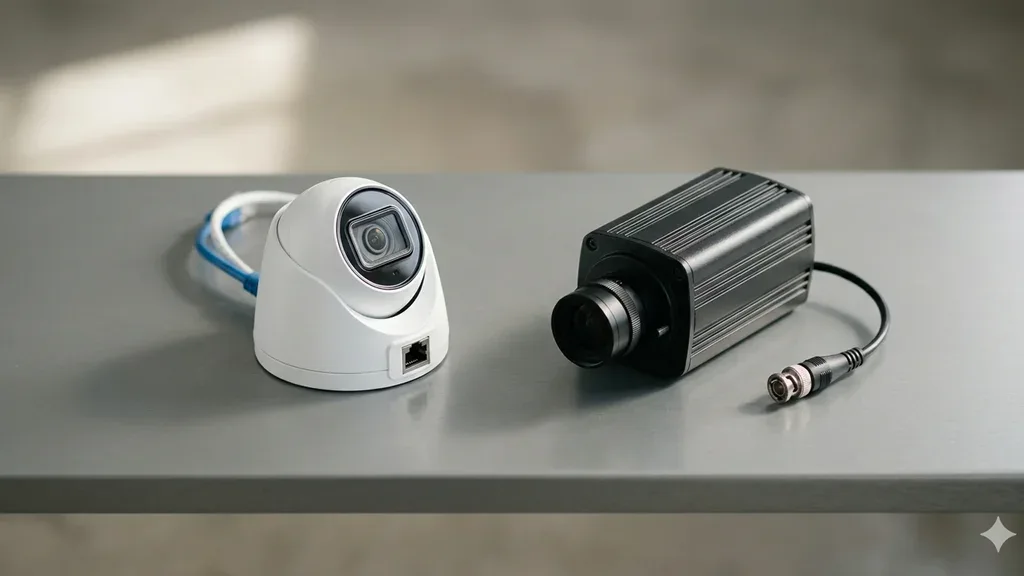
What Analogue CCTV Actually Is Today
Analogue CCTV in 2026 isn't the blurry footage from 1990s CCTV. Modern analogue uses HD-CVI, AHD, or TVI standards — delivering up to 4K resolution over traditional coaxial cable. A DVR (Digital Video Recorder) converts the analogue signal to digital for storage and viewing. Analogue systems are still sold and installed in Australia, typically as budget replacements for existing coaxial infrastructure.
The key limitation: analogue requires a separate coaxial cable per camera + a separate power cable. That's two cable runs per camera. IP cameras need only one cable (Ethernet carries both data and power via PoE).
What an IP Camera System Is
IP cameras are networked devices. Each camera connects via a single Cat5e/6 Ethernet cable to an NVR (Network Video Recorder) or records directly to cloud storage. Power comes through the same cable via PoE (Power over Ethernet) — one cable per camera, carrying both video and power.
IP cameras process video on-board (edge computing) before sending it to the NVR. This means AI analytics (person detection, vehicle detection, line-crossing, loitering alerts) run on the camera itself — not the recorder. This is why 2026 IP systems are dramatically more intelligent than analogue equivalents.
Image Quality Comparison
| Spec | Analogue (HD-CVI/AHD/TVI) | IP (PoE NVR) |
|---|---|---|
| Max resolution | 4K (8MP) — but rare in practice | 4K (8MP) — widely available and affordable |
| Common residential spec | 2MP (1080p) | 4MP–5MP (2K+) |
| AI analytics | None (DVR does basic motion only) | On-camera person/vehicle/object detection |
| Digital zoom quality | Degrades quickly past 2× on 1080p | Usable to 4× on 4MP+, clean at 8MP |
Cabling Differences — Why This Matters for Installation Cost
Analogue: Each camera needs a coaxial video cable + a separate power cable from the PSU. Two cable runs per camera. For retrofits using existing coaxial infrastructure, this is free — the cables are already in the walls. For new installs, double cable runs mean double the labour.
IP (PoE): Each camera needs one Cat5e or Cat6 Ethernet cable. PoE delivers power over the same cable — no separate power run. One cable per camera, one PoE switch or NVR with built-in PoE ports. For new installs, IP cabling is faster and cheaper to run. For retrofits in homes with existing coaxial, you'd need to pull new Ethernet cable — which may negate the cost advantage.
Cost Comparison — Installed in Sydney
| System | 4-camera installed | 8-camera installed |
|---|---|---|
| Analogue HD (2MP, DVR) | $800–$1,500 | $1,500–$2,800 |
| IP (4MP, NVR, PoE) | $1,800–$2,800 | $3,000–$5,000 |
| IP (4K/8MP, NVR, AI detection) | $2,500–$4,000 | $4,500–$7,000 |
IP costs more upfront but delivers significantly better image quality, AI analytics, and easier expansion. Analogue is cheaper for basic coverage where existing coaxial cabling exists.
Which System SRS Recommends
Ready to upgrade your Sydney CCTV to IP?
SRS installs Hikvision, Dahua and Axis IP camera systems across Sydney — 4K resolution, secure NVR storage, fixed-price installs. Licensed, insured, ML 000108002.
Get a Free CCTV Quote →For new installations in 2026: IP every time. The image quality, AI analytics, single-cable simplicity, and future expansion path are worth the premium. Hikvision, Dahua, and Uniview all offer 4MP+ IP systems at competitive prices in Australia.
For existing analogue systems that still work: keep them until they fail or until you need features analogue can't provide (AI detection, remote 4K viewing, cloud backup). Then upgrade to IP when the replacement happens naturally. Don't replace a working system just because IP is newer.
For budget-constrained installations: a 4-camera IP system (4MP, NVR, PoE) costs $1,800–$2,800 installed in Sydney. That's the entry point for a genuinely modern system. Below that price point, analogue HD is the realistic option — and 1080p analogue still captures usable footage for most residential scenarios.
Frequently Asked Questions
Is IP CCTV better than analogue in 2026?+
For new installations, yes. IP offers higher resolution (4MP–8MP vs 1080p typical), AI-powered person/vehicle detection, single-cable PoE installation, and easier remote viewing. Analogue is still acceptable for budget installs or properties with existing coaxial infrastructure.
Can I upgrade my analogue CCTV to IP?+
Yes, but it typically means replacing cameras, recorder, and cabling — essentially a new system. If your existing coaxial cabling is in good condition, some hybrid NVRs can run both analogue and IP cameras during a staged transition. A licensed installer can assess the most cost-effective upgrade path.
Is analogue CCTV still being sold in Australia?+
Yes — analogue HD systems (HD-CVI, AHD, TVI) are still sold and installed, primarily for budget replacements of existing coaxial systems. Major brands (Dahua, Hikvision) still manufacture analogue-compatible cameras. However, the industry is clearly moving to IP for all new installations.
What is PoE and why does it matter for CCTV?+
Power over Ethernet (PoE) delivers electrical power through the same Ethernet cable that carries the video data. This means each IP camera needs only ONE cable (vs two for analogue — coaxial + power). PoE simplifies installation, reduces cable runs, and lowers labour cost. The PoE switch or NVR provides power centrally.
Do IP cameras need internet to work?+
No — IP cameras connect to a local NVR via your home network (switches and cables), not the internet. Recording and playback work without any internet connection. Internet is only needed for remote viewing from your phone when you're away from home. If internet drops, recording continues locally.
How much does an IP CCTV system cost in Sydney?+
A 4-camera 4MP IP system with NVR and PoE costs $1,800–$2,800 installed in Sydney. An 8-camera 4K system with AI detection runs $4,500–$7,000. Comparable analogue systems cost 30–50% less but with significantly reduced capabilities.
Ready to upgrade to modern IP CCTV?
We'll assess your existing system, advise on upgrade vs replace, and give you a clear per-camera price for the right IP setup.
Related Reading
- Buyer GuideCCTV Camera Types ExplainedOnce you've chosen IP, pick the right camera shape for each location.
- Cost GuideCCTV System Cost SydneyFull installed cost breakdown for residential and commercial IP systems.
- ComplianceCCTV Footage RetentionIP NVR storage sizing affects how long your footage is kept.
- Decision guideHow Many CCTV Cameras?Topical neighbour.