
EV Charger Insights • Sydney • 2026
Tesla Wall Connector vs Universal Type 2 Charger — Which Should You Install in Sydney?
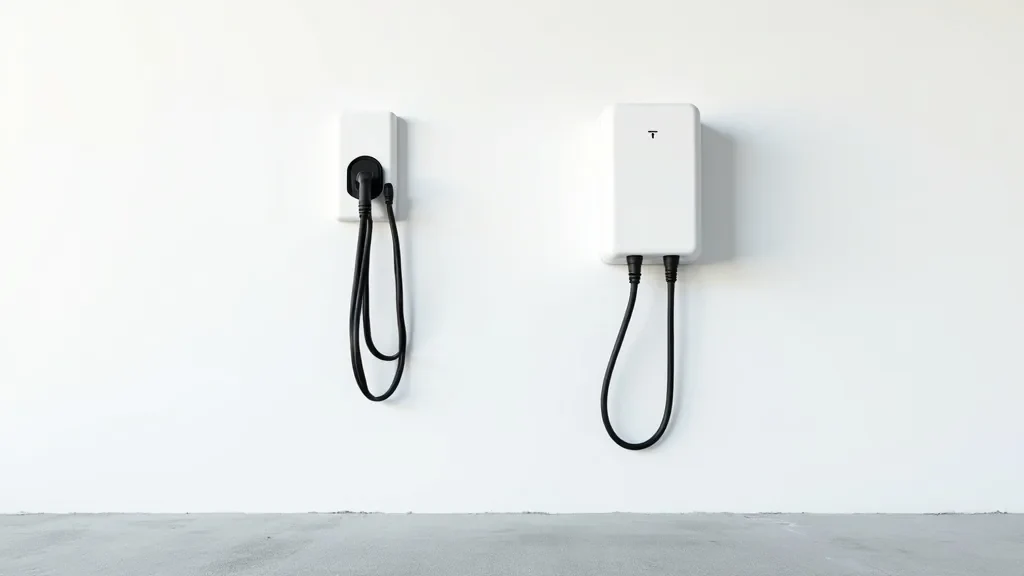
If you’re 100% sure your next two cars will both be Teslas, the Tesla Wall Connector Gen 3 is the right buy — cleaner Tesla app integration, and a typical Sydney install runs $300 to $700 cheaper than an equivalent Wallbox, Evnex or Zappi. For everyone else — mixed households, future resale, strata bays, anyone who might switch brand — a universal Type 2 charger is safer. Here’s the installer’s view: where Tesla wins, where it locks you in, and what the connector actually looks like.
The Short Answer: Which Should You Buy?
| Buyer profile | Pick |
|---|---|
| Tesla driver, plan to stay Tesla 5+ years | Tesla Wall Connector Gen 3 |
| Mixed household — one Tesla, one non-Tesla | Universal Type 2 (or Tesla Gen 3, see below) |
| Non-Tesla driver who likes Tesla aesthetics | Universal Type 2 |
| Buying for a rental property / future-proofing for resale | Universal Type 2 |
| Strata bay where the next resident may not drive a Tesla | Universal Type 2 |
The decision isn’t about hardware quality — both sides are excellent — but who else might use this charger over the next ten years.
Hardware + Install Cost Comparison, Sydney April 2026
| Charger | Typical hardware (AUD) | Typical Sydney installed price (≤5m run) |
|---|---|---|
| Tesla Wall Connector Gen 3 (Type 2 in AU spec) | $750 – $950 | $1,500 – $1,800 |
| Wallbox Pulsar Plus 7kW | $1,100 – $1,400 | $1,799 – $2,200 |
| Evnex E2 (NZ–AU made) | $1,300 – $1,600 | $1,899 – $2,400 |
| Zappi v2.1 (myenergi, solar-aware) | $1,650 – $1,950 | $2,200 – $2,800 |
| Schneider EVlink Pro | $1,400 – $1,750 | $2,000 – $2,500 |
Sydney market estimates. Cable run, switchboard work, and load management add to all numbers equally — they’re not Tesla-vs-universal differences.
The Connector Question — What's Actually on the Wall
The most misunderstood part of the whole comparison, so worth getting right up front.
The Tesla Wall Connector Gen 3 sold in Australia ships with a Type 2 plug — the same physical connector as every other home charger on the market. Wallbox, Evnex, Zappi, Schneider — all Type 2. So is the Tesla.
That means a Tesla Wall Connector will physically charge any Type-2-equipped EV: Hyundai Ioniq 5, BYD Atto, Polestar, Kia EV6, MG. Plug fits, charging starts, kilowatts flow. The “Tesla lock-in” concern is no longer about the plug — it’s about the software, and what features you keep or lose when you mix brands.
Older online debate predates the AU-spec Type 2 changeover and gets repeated as if it still applies. It doesn’t.
Smart Features — Tesla App vs OCPP Open Standards
This is where the real difference lives.
Tesla Wall Connector integrates with the Tesla app: scheduling, off-peak charging, fleet sync, automatic energy logging, and — paired with a Tesla Powerwall — basic solar diversion. Every charge session shows up in the same app you already use to unlock and warm the car. Inside the Tesla ecosystem, it’s the best experience on the market.
Wallbox, Evnex and Zappi support OCPP 1.6 (and increasingly 2.0) — an open protocol used by every serious charge management platform. That opens up third-party energy management, dynamic load balancing, smarter solar-aware charging regardless of car brand, and integration with home energy systems. Schneider EVlink Pro also supports OCPP and ties into Schneider’s Wiser stack if you have one.
Honest read: if you don’t drive a Tesla, the Tesla app is dead weight. If you do, OCPP is dead weight. Pick the one that matches the car in your driveway.
Solar-Aware Charging — Where Tesla and Universal Differ
Most Sydney EV homes either have solar or will, so this matters.
- Tesla Wall Connector + Tesla Powerwall does basic solar diversion through the Tesla app. Clean if you're all-Tesla.
- Zappi v2.1 is the gold standard for solar-aware charging regardless of car brand. Diverts only excess solar (eco+ mode), works with any 6.6kW–10kW system, doesn't care if the car is a Tesla or a BYD.
- Wallbox Pulsar Plus supports solar-aware via the myWallbox app and Quasar ecosystem.
- Evnex handles it through OCPP plus its own cloud, with strong AU and NZ presence.
- Schneider EVlink Pro integrates through Schneider's Wiser energy management.
If solar diversion is a top-three reason you’re installing a charger, Zappi is the strongest pick — and that’s brand-agnostic.
Warranty + AU Support
Typical bands as of April 2026 — confirm current spec at quote time:
- Tesla Wall Connector Gen 3 — typical 4-year warranty, supported through the Tesla service network. Direct-from-manufacturer relationship.
- Wallbox Pulsar Plus — typical 3-year, supported through AU distributors with good national coverage.
- Evnex E2 — typical 3-year, NZ-based with strong AU presence and local distribution.
- Zappi v2.1 — typical 3-year, myenergi UK with AU support through local distribution.
- Schneider EVlink Pro — typical 3-year, supported through Schneider's existing electrical AU network.
All are credible. Tesla has the longest standard warranty by a year, and the most direct support relationship.
Install Cost Difference — Why Tesla Is Cheaper
The $300–$700 saving is real and structural, not marketing.
- Smaller hardware footprint and simpler enclosure
- Faster commissioning — pairs to the Tesla app on the spot, no cellular module
- Often bundled or discounted at vehicle purchase, dropping hardware below retail
- Less installer-side configuration vs an OCPP charger on a third-party platform
For an identical cable run, the labour hour count is lower. That’s what shows up in the quote.
The Future-Resale Argument
The next buyer of your house in 2031 may drive a Hyundai, BYD, Kia, Polestar, MG or whatever’s launched by then. None will use the Tesla app.
A Tesla Wall Connector still works for those buyers — charges their car fine through the Type 2 plug — but the Tesla-specific smart features become dead weight. A universal charger stays useful no matter what’s parked in the garage.
Net impact on resale price? Small. Most buyers don’t price the difference in. But worth weighing if you’re installing in a property you might sell within five years.
The Household-Switch Scenario
Common Sydney pattern: buy a Tesla today, add a Hyundai Ioniq 5 or BYD Atto in three years as a second car.
- Tesla Wall Connector — both cars charge via the Type 2 plug. Tesla gets the full app experience. The non-Tesla just charges, no app.
- Universal Type 2 charger — both charge equally. Neither gets the Tesla app. Both get whatever app the universal unit ships with.
Either path works. The decision is which inconvenience you’d rather wear: losing app integration for the second car, or losing the Tesla experience for the first.
What About Adapters?
A non-issue at home. All AU-spec home charging — Tesla and otherwise — is now Type 2. The “Tesla CCS adapter” and similar accessories in overseas guides relate to older proprietary plugs in other markets. In an AU home in 2026, the plug on the wall is Type 2 either way.
Frequently Asked Questions
Does a Tesla Wall Connector charge a non-Tesla car?+
Yes. The current AU-spec Tesla Wall Connector Gen 3 has a Type 2 plug and charges any Type-2-equipped EV. The non-Tesla just doesn't get Tesla app integration — charging itself works normally.
Will my Tesla charge from a Wallbox, Evnex or Zappi?+
Yes. All use the same Type 2 plug. The Tesla charges through the car's standard interface — the wall unit just won't feed session info into the Tesla app.
Is the Tesla Wall Connector cheaper to install?+
Usually yes. A typical Sydney install runs $300–$700 cheaper than an equivalent Wallbox, Evnex or Zappi install for the same cable run.
What about V2H or V2G bidirectional charging?+
Neither Tesla Wall Connector nor mainstream universal Type 2 chargers currently support bidirectional. V2H is a separate hardware category — see our bidirectional EV charging post.
Can I add a second charger later?+
Yes for both. Universal Type 2 chargers handle a second unit through OCPP load balancing. Tesla supports up to four paired Wall Connectors with shared-load behaviour built in.
Related Reading
- ReadEV Charger Installation Sydneyfull install scope, switchboard checks, NSW compliance
- ReadBest Home EV Charger Brands in Australiabroader brand comparison
- ReadSmart vs Basic EV Charger — Which Do You Actually Need?feature-tier decision before brand
- ReadEV Charger Installation Cost Sydney 2026current Sydney install pricing
- ReadBidirectional EV Charging in Sydney — V2H and V2Gwhen (and whether) to wait for V2H
Need a quote on your EV charger?
Site inspection across Sydney, written quote before any work starts, fixed-price scope. No pushy upsell.