
NSW Compliance • Privacy • CCTV
NSW Privacy Laws and Home Security Cameras: What You Can and Cannot Record
You can legally install CCTV on your own property in NSW. You cannot record audio without consent. You should not point cameras at your neighbour’s private areas. And if you’re in a strata building, you need owners corporation approval for common property. Here’s the full legal picture — explained by licensed Sydney security installers who configure compliant systems every day.
Primary sources: Australian Privacy Principles · NSW Police home security guidance.
What the Surveillance Devices Act 2007 Actually Says for Homeowners
The Surveillance Devices Act 2007 (NSW) is the primary law governing CCTV use in private settings. For homeowners, the key rules are:
- Video recording on your own property is legal. You can install cameras on your house, in your yard, on your fence — anywhere on property you own or have the right to occupy.
- Audio recording without consent is illegal. Recording a private conversation without the consent of all parties is a criminal offence under Part 2 of the Act. Standard CCTV must be configured video-only. If your camera has a built-in microphone, it should be disabled unless you have explicit signed consent from everyone who speaks near it.
- The Act was tightened in March 2026. The Surveillance Devices Amendment (Public Interest Exceptions) Bill 2025, passed in early 2026, further restricted the possession and distribution of unlawfully recorded material.
Where You Can Legally Point Your Camera
The NSW Information and Privacy Commission (IPC) provides clear guidance:
- Your property: Front door, driveway, garage, backyard, side paths — all legal. Cameras should be aimed to capture your property and the approach to it.
- Public areas visible from your property: The footpath and street immediately in front of your house can be incidentally captured. This is generally acceptable because these areas have no expectation of privacy.
- Your neighbour's property: Do NOT aim cameras at your neighbour's yard, windows, balcony, or private outdoor areas. Even if a camera technically points at your fence line, if the field of view captures their private space, this may constitute an invasion of privacy.
The practical rule: aim cameras to capture the approach to your property, not beyond your property boundary. A licensed installer will set each camera angle to cover your zones without crossing into neighbour territory.
Strata and Apartment Buildings — Additional Rules
NSW strata buildings have three extra layers of regulation:
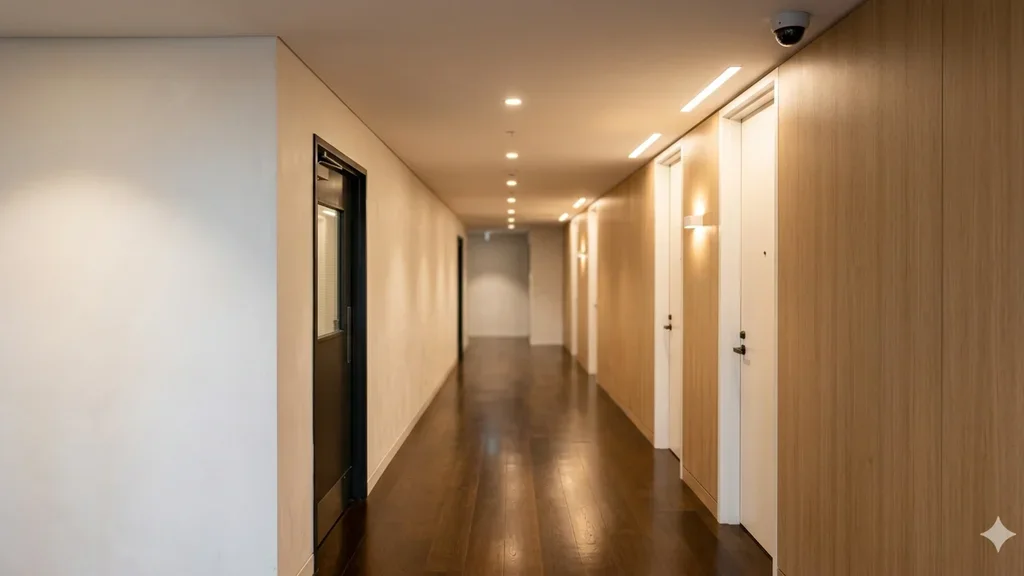
- Common property: Installing cameras in lobbies, car parks, hallways, lift lobbies, or any shared space requires an owners corporation special resolution and a specific by-law governing the camera's use, access, and maintenance. NCAT has twice ordered removal of unauthorised common-area cameras at the lot owner's expense.
- Signage: If cameras cover common areas, signage must be displayed at every access point to the surveilled area.
- Inside your own lot: You can install cameras inside your apartment or on your private balcony without OC approval — it's your lot. But any camera visible from common areas (e.g. a doorbell camera in a shared corridor) exists in a grey zone and should be discussed with the strata manager first.
What Happens If a Neighbour Complains About Your Camera?
Neighbour CCTV disputes are one of the fastest-growing complaint categories at the NSW IPC. If a neighbour complains:
- Talk first. Most disputes are resolved by adjusting the camera angle — a 5-degree tilt can remove their yard from the frame entirely.
- If talking fails: The neighbour can complain to the NSW IPC, which may investigate and recommend changes.
- If it escalates: In extreme cases, a court can order camera removal if the installation is found to unreasonably invade the neighbour's privacy.
- Prevention is better: A licensed installer will set angles to cover only your property from day one. We use field-of-view testing tools on-site to confirm compliance before leaving.
Frequently Asked Questions
Can I legally install CCTV cameras on my home in NSW?+
Yes. Installing video-only CCTV on property you own or occupy is legal in NSW. The cameras should cover your property and the approach to it. Audio recording without consent is illegal under the Surveillance Devices Act 2007.
Can my security camera record audio in NSW?+
Not without the consent of all parties to the conversation. Recording private conversations without consent is a criminal offence under Part 2 of the Surveillance Devices Act 2007 (NSW). Professional installs configure cameras as video-only by default. If your camera has a microphone, disable it.
Can I point my camera at my neighbour's fence in NSW?+
Your camera can capture your own property up to the fence line. It should not capture your neighbour's private areas — their yard, windows, balcony, or private outdoor spaces. If your camera's field of view incidentally captures the top of their fence, that's generally acceptable. If it captures their living space, adjust the angle.
Do I need to put up a sign if I have CCTV at home in NSW?+
There's no legal requirement for a homeowner to display CCTV signage on a private residence in NSW. However, it's good practice — a visible camera and sign acts as a deterrent. For businesses, signage is legally required under the Workplace Surveillance Act 2005.
Can I install a camera in my strata apartment corridor?+
Not on common property without owners corporation approval. The corridor is common property, and any camera installation there requires a special resolution and a specific by-law. Installing without approval risks an NCAT removal order at your expense. Inside your own apartment, you can install cameras freely.
What should I do if my neighbour complains about my CCTV?+
Start by talking — most disputes resolve with a camera angle adjustment. If they remain concerned, offer to show them the camera's view to prove it doesn't capture their private areas. If the dispute escalates, they can complain to the NSW IPC. Prevention: have a licensed installer set compliant angles from day one.
Want a CCTV system that's fully compliant from day one?
We configure every camera angle on-site to cover your property without crossing into neighbour territory. Video-only, properly aimed, with field-of-view verification before we leave.
Related Reading
- ComplianceCCTV in Strata Buildings NSWDeeper dive on the strata-specific rules and OC approval process.
- ComplianceWorkplace Surveillance Laws NSWIf you're a business owner, different rules apply — here's the full picture.
- Buyer GuideHow Many Cameras Do I Need?Once you know the legal boundaries, work out how many cameras cover your property.